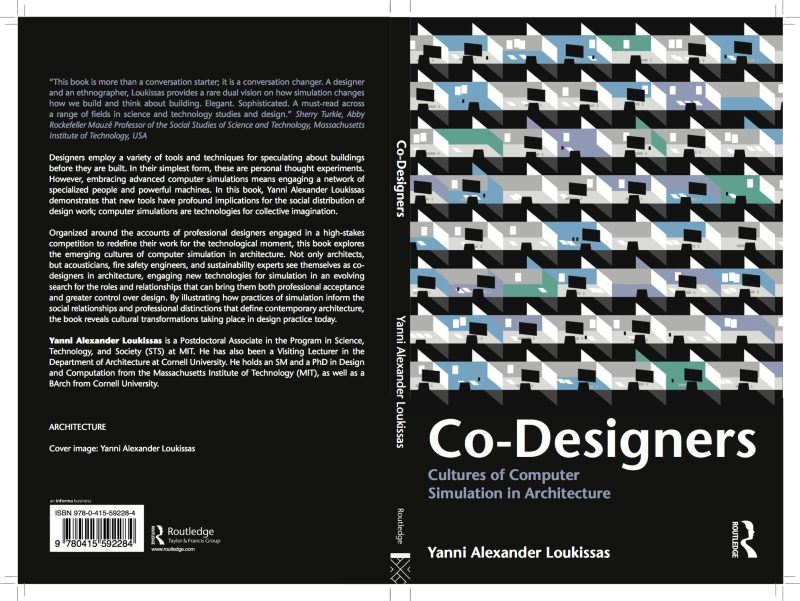
Designers employ a variety of tools and techniques for speculating about buildings before they are built. In their simplest form, these are personal thought experiments. However, embracing advanced computer simulations means engaging a network of specialized people and powerful machines; computer simulations are technologies for collective imagination. In this book, I critically examine new design tools and their implications for the social distribution of creative work.
Organized around the accounts of professional designers engaged in a high-stakes competition to redefine their work for the technological moment, this research explores the emerging cultures of computer simulation in architecture. Not only architects, but acousticians, fire safety engineers, and sustainability experts see themselves as co-designers in architecture, engaging new technologies for simulation in an evolving search for the roles and relationships that can bring them both professional acceptance and greater control over design. By illustrating how practices of simulation inform the social relationships and professional distinctions that define contemporary architecture, this book reveals the cultural transformations taking place in design practice today.
Published by Routledge in 2012.
What people are saying about Co-Designers:
“This book is more than a conversation starter; it is a conversation changer. A designer and an ethnographer, Loukissas provides a rare dual vision on how simulation changes how we build and think about building. Elegant. Sophisticated. A must-read across a range of fields in science and technology studies and design.”
– Sherry Turkle, Abby Rockefeller Mauzé Professor of theSocial Studies of Science and Technology, Massachusetts Institute of Technology, USA
“One of the things that often gets missed in stories of technological change is the way that it often accompanies changes in professional relations, and that’s something that Co-Designers illustrates beautifully”
– Paul Dourish, professor, Donald Bren School of Information and Computer Sciences at the University of California at Irvine, USA
Read about Co-Designers in the MIT News:
“Bits of buildings: How is computing changing the architect’s job? In a new book, an MIT researcher looks at the influence of high-tech simulations on the profession of architecture.” -Peter Dizikes, MIT News Office